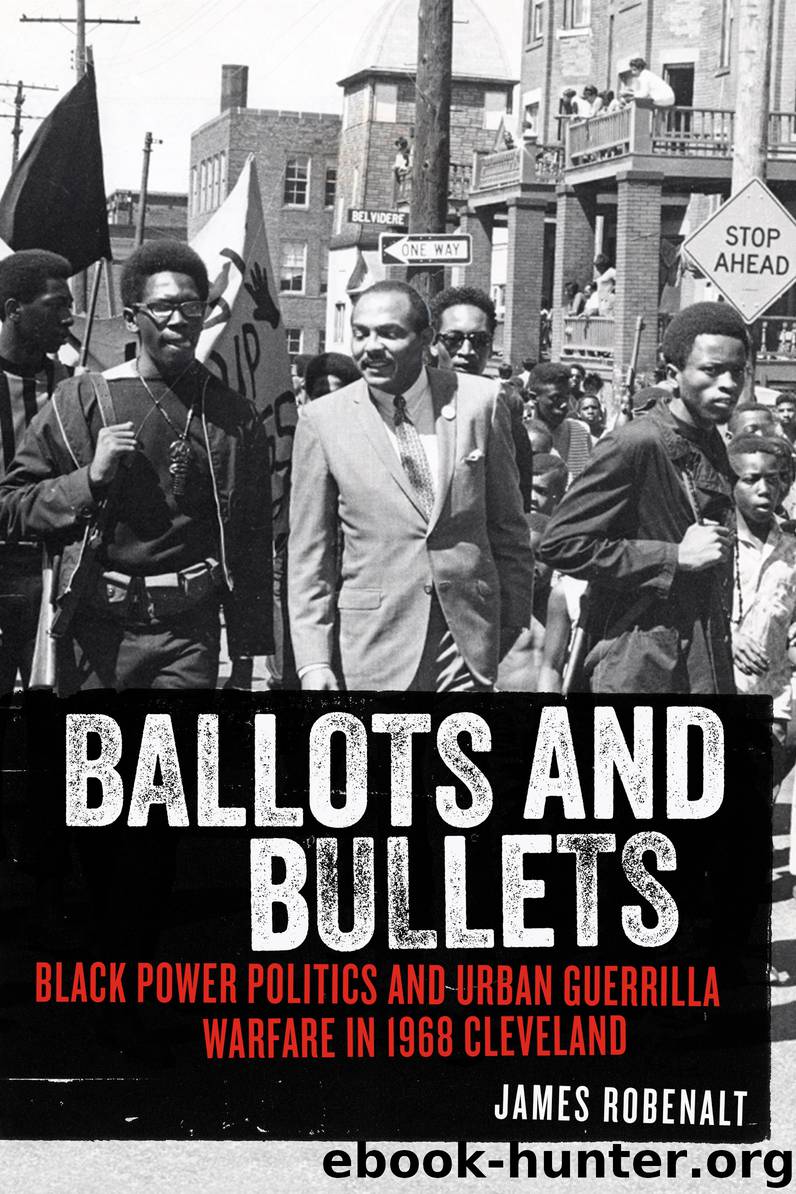
Ballots and Bullets by James Robenalt
Author:James Robenalt
Language: eng
Format: epub
Publisher: Chicago Review Press
Published: 2018-12-09T16:00:00+00:00
19
“As Lambs for the Slaughter”
TWO DAYS AFTER MARTIN LUTHER King Jr. came to Cleveland to register voters, the FBI formalized its counterintelligence program against black nationalists. In a memo dated August 25, 1967, the director of the FBI issued a letter to twenty-three select field offices (including Cleveland) with instructions to establish a control file and assign responsibility for counterintelligence to “an experienced and imaginative Special Agent well versed in investigations relating to black nationalists, hate-type organizations.”
In Cleveland that man would be Special Agent John J. Sullivan, a longtime agent who was originally from New York. In FBI parlance, he “pulled the ticket.”1
The COINTELPRO letter made the purpose of the endeavor entirely clear: it was to “expose, disrupt, misdirect, discredit, or otherwise neutralize the activities of black nationalists, hate-type organizations and groupings, their leadership, spokesmen, membership, and supporters, and to counter their propensity for violence and civil disorder.” The dictate was to “follow on a continuous basis” black nationalist groups “so we will be in a position to promptly take advantage of all opportunities for counterintelligence and to inspire action in instances that warrant.”
Special attention was to be paid to SNCC, SCLC, and RAM. By name, agents were directed to place emphasis on “extremists who direct the activities and policies of revolutionary or militant groups such as Stokely Carmichael, H. ‘Rap’ Brown, Elijah Muhammad, and Maxwell Stanford.” Because of the nature of the program, agents were cautioned that “under no circumstances should the existence of the program be made known outside the Bureau.”2
Part of this counterintelligence program was to locate and pay confidential informants. Within the FBI, the effort to identify sources to infiltrate black nationalist groups became known as the “Ghetto Informant Program,” or the “Ghetto Listening Post.” Thousands of sources or “assets” were employed over the next year across the United States.3 In Cleveland at least five informants provided information on Fred Ahmed Evans and his group.
One informant, identified as T-5, gave a detailed report of a workshop that took place at the Karamu House in Cleveland (a multicultural theater and settlement house established in 1915) the weekend after Carl Stokes won his primary race against Ralph Locher. “CV T-5 advised on October 11, 1967, that over 200 people registered for the Black Unity Conference held at Karamu House, East 89th Street and Quincy Avenue, Cleveland Ohio, on October 6–8, 1967,” the report read. “Source identified FRED EVANS as one of those in attendance.”
The unity conference, calling on blacks from across Ohio, was chaired by Walter Beach, now out of football and working as an investigator for the Legal Aid Society of Cleveland, an organization to provide legal services to those unable to afford a lawyer. “I canvassed the neighborhoods, including the pool halls, to identify people who might be in trouble and in need of the assistance of Legal Aid,” Beach recalled.
Beach was asked by Ahmed Evans, Harllel Jones, and other nationalists (Baxter Hill and DeForest Brown) to chair the unity event because of his celebrity as a former Browns player.
Download
This site does not store any files on its server. We only index and link to content provided by other sites. Please contact the content providers to delete copyright contents if any and email us, we'll remove relevant links or contents immediately.
| Africa | Americas |
| Arctic & Antarctica | Asia |
| Australia & Oceania | Europe |
| Middle East | Russia |
| United States | World |
| Ancient Civilizations | Military |
| Historical Study & Educational Resources |
Cat's cradle by Kurt Vonnegut(15362)
Pimp by Iceberg Slim(14517)
4 3 2 1: A Novel by Paul Auster(12397)
Underground: A Human History of the Worlds Beneath Our Feet by Will Hunt(12100)
The Radium Girls by Kate Moore(12033)
Wiseguy by Nicholas Pileggi(5791)
The Fire Next Time by James Baldwin(5452)
Perfect Rhythm by Jae(5409)
American History Stories, Volume III (Yesterday's Classics) by Pratt Mara L(5310)
Paper Towns by Green John(5194)
Pale Blue Dot by Carl Sagan(5012)
A Higher Loyalty: Truth, Lies, and Leadership by James Comey(4965)
The Mayflower and the Pilgrims' New World by Nathaniel Philbrick(4506)
The Doomsday Machine by Daniel Ellsberg(4492)
Killers of the Flower Moon: The Osage Murders and the Birth of the FBI by David Grann(4449)
The Sympathizer by Viet Thanh Nguyen(4396)
Too Much and Not the Mood by Durga Chew-Bose(4349)
The Borden Murders by Sarah Miller(4329)
Sticky Fingers by Joe Hagan(4204)
